Target Heart Rate Zones Calculator
Find your 5 heart rate zones, Zone 2 range, and target heart rate by age using the Karvonen formula or a percentage of your max heart rate.
Used to estimate your age-predicted maximum heart rate (220 − age).
Check your pulse for 60 seconds first thing in the morning. Used by the Karvonen Heart Rate Reserve formula.
Using Karvonen Heart Rate Reserve: accounts for your resting pulse to personalize aerobic and conditioning thresholds.
| Zone | Intensity | Target BPM | Training Feel & Breathing Cue |
|---|---|---|---|
| Zone 1 · Recovery | 50%–60% | 123–134 BPM | Easy warmup, cooldown, and active recovery between heavy sets. Full sentences feel effortless. |
| Zone 2 · Aerobic Base | 60%–70% | 134–146 BPM | Builds aerobic stamina and burns fat without beating up your joints. You can speak in full sentences. |
| Zone 3 · Tempo | 70%–80% | 146–157 BPM | Steady conditioning circuits and sustained pace work. Speaking in short phrases. |
| Zone 4 · Threshold | 80%–90% | 157–169 BPM | 3-minute boxing rounds and hard intervals. Deep breathing; a few words at a time. |
| Zone 5 · Peak Output | 90%–100% | 169–180 BPM | Short 10–20 second all-out sprints, followed by full recovery. |
These numbers are general fitness estimates for educational use. Talk with your doctor or healthcare provider before changing your exercise or diet. Any information you enter is kept local and private on your device.
How the Karvonen formula calculates your target heart rate zones
Standard heart rate charts only use your age (`220 − age`), which gives two 45-year-olds with very different fitness levels the exact same numbers. The Karvonen Heart Rate Reserve formula subtracts your resting heart rate from your estimated max heart rate to find your working range, then adds your resting pulse back in. That gives you much more useful BPM targets for Zone 2 cardio, boxing rounds, and recovery between sets.
Blood pressure medications, pregnancy, caffeine, and gym temperature all shift your pulse from day to day. During one-on-one sessions in Harrisburg, A’mas pairs these BPM zones with the talk test so older adults and prenatal clients stay at a safe, steady effort.
What are the 5 heart rate zones?
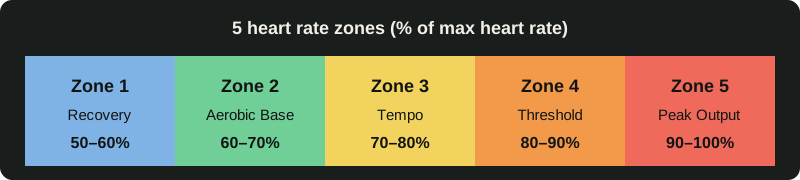
There are five heart rate zones, each a 10% band of your maximum heart rate, shown below from easiest to hardest. Other charts and apps sometimes use different zone models, so always check which one you are comparing against.
- Zone 1 (50–60%): recovery, warmups, and cooldowns.
- Zone 2 (60–70%): easy aerobic base work at a conversational pace.
- Zone 3 (70–80%): tempo and steady conditioning.
- Zone 4 (80–90%): threshold work and hard intervals.
- Zone 5 (90–100%): short, all-out efforts.
Heart rate zones by age
This chart shows target heart rate zones by age using the standard method: estimated max heart rate is 220 − age, and each zone is a percentage of that number. It matches the calculator above when the Standard (% Max HR) option is selected. For numbers that account for your resting pulse, use the Karvonen option instead.
| Age | Max HR | Zone 1 | Zone 2 | Zone 3 | Zone 4 | Zone 5 |
|---|---|---|---|---|---|---|
| 20 | 200 | 100–120 | 120–140 | 140–160 | 160–180 | 180–200 |
| 25 | 195 | 98–117 | 117–137 | 137–156 | 156–176 | 176–195 |
| 30 | 190 | 95–114 | 114–133 | 133–152 | 152–171 | 171–190 |
| 35 | 185 | 93–111 | 111–130 | 130–148 | 148–167 | 167–185 |
| 40 | 180 | 90–108 | 108–126 | 126–144 | 144–162 | 162–180 |
| 45 | 175 | 88–105 | 105–122 | 122–140 | 140–158 | 158–175 |
| 50 | 170 | 85–102 | 102–119 | 119–136 | 136–153 | 153–170 |
| 55 | 165 | 83–99 | 99–115 | 115–132 | 132–149 | 149–165 |
| 60 | 160 | 80–96 | 96–112 | 112–128 | 128–144 | 144–160 |
| 65 | 155 | 78–93 | 93–109 | 109–124 | 124–140 | 140–155 |
| 70 | 150 | 75–90 | 90–105 | 105–120 | 120–135 | 135–150 |
What is my zone 2 heart rate? How to calculate it
Zone 2 heart rate is 60–70% of your maximum heart rate. To calculate it, subtract your age from 220 to estimate max heart rate, then multiply by 0.6 and 0.7. For a 40-year-old: 220 − 40 = 180, and 180 × 0.6 = 108 and 180 × 0.7 = 126, so zone 2 is about 108–126 BPM. Use the calculator above to get your own number, and the talk test as a cross-check: you should be able to speak in full sentences.
Karvonen formula worked example
Take a 40-year-old with a resting heart rate of 60 BPM. Max heart rate is 220 − 40 = 180, so heart rate reserve is 180 − 60 = 120. Zone 2 runs from 60 + (0.6 × 120) = 132 BPM to 60 + (0.7 × 120) = 144 BPM. Enter age 40 and resting heart rate 60 in the Karvonen calculator above and you will see the same 132–144 BPM.
How do I find my resting heart rate?
Sit or lie still when you wake up, before caffeine or getting out of bed. Find your pulse at your wrist or neck, count beats for 60 seconds, and repeat over a few mornings. Average the results for a steadier number.
Want help turning these numbers into a plan? Exploresenior fitness training orstrength and conditioningwith A’mas in Harrisburg.
Heart rate zone FAQs
How many heart rate zones are there?
Five: recovery, aerobic base (zone 2), tempo, threshold, and peak output. Each is a 10% band from 50% up to 100% of your max heart rate — see the chart and table above for the exact ranges.
What is my zone 2 heart rate by age?
Using the standard method, zone 2 is 60–70% of 220 − age. At 30 that is about 114–133 BPM, at 40 about 108–126 BPM, and at 50 about 102–119 BPM. See the age table above or use the calculator for your exact range.
Should I use % max heart rate or the Karvonen formula?
The standard method uses only your age. The Karvonen formula also uses your resting heart rate, so it personalizes the zones. Both are estimates, and the calculator lets you switch between them.
Why is 220 minus age only an estimate?
It is a population average, so individual max heart rates can differ noticeably from it. Treat the results as a starting point and pair them with how the effort feels, such as the talk test.
How often should I train in zone 2?
There is no single answer. Many people include easy zone 2 sessions a few times per week alongside strength work, depending on their goals, schedule, and recovery. A trainer can help you set a plan.
When should I talk to a doctor about heart rate training?
Check with a doctor before starting if you have a heart condition, take medication that affects heart rate, are pregnant, or feel chest pain, dizziness, or unusual shortness of breath during exercise.